Weaving and other fiber-based fun for 45 years and counting
Find the current newsletter on our webpage, under the Members tab. Look for Newsletter Archives.
Or click here.
CWG SPRING Newsletter MAR 2021 copy 3
Please send newsletter materials that you might have on hand. None?
Well, would you consider creating some? Perhaps photos of your projects, a new technique or yarn you are trying, a weaving reference book you have discovered. Or even an essay about your weaving adventures, discoveries, or compatriots. Perhaps a quandary that you would like help with. And don’t forget news of your doings, notes about upcoming programs, updates from membership, library, workshops.
Surely you have something.
Rev your engines.
Embroidered phulkari textiles on view in Handmade Creating Textiles in South Asia, Photo by Lori Kartchner.
https://museum.gwu.edu/handmade-creating-textiles-south-asia
Artists, cooperatives, and workshops across Bangladesh, India, and Pakistan are creating new textile designs inspired by centuries-old traditions. Join George Washington University art history professor Cristin McKnight Sethi and curator of the forthcoming exhibition, “Handmade: Creating Textiles in South Asia,” at the GW Textile Museum as she shares artist stories alongside vibrant examples of handmade saris, scarves, and other garments. To learn more about the exhibition and related programming please visit https://museum.gwu.edu/handmade-creating-textiles-south-asia.
Join us for a presentation by member Laura Martin. As a Cleveland Museum of Art docent, she has prepared a talk.
Zoom details will be emailed via emailldodo–the evening before or morning of Feb 18
11:30 am Chat.
12 noon Meeting.
Presentation by Laura Martin following meeting.
HINT:
March 1 will be here sooner than you think. That means a Newsletter deadline approaches.
| Contact Form from CWG Website The Toledo Area Weavers Guild is hosting a virtual workshop on Crackle Weave on 4-shafts with Susan Conover. It will take place April 10 & 11, 2021. This will be two days of weaving on the loom, lectures and instruction. Cost: $100. Contact Lou Ann Glover : lglover@mvcds.org for all the details. Phone: 419-824-5373 |
|
||||||||||||
|
Please join us via Zoom at 11:30 am.
Zoom link information will come via emaildodo.
Contact newsletter@cuyahogaweaversguild.com if you’d like to visit the meeting as a non-member.
Embroidered phulkari textiles on view in Handmade Creating Textiles in South Asia, Photo by Lori Kartchner.
https://museum.gwu.edu/handmade-creating-textiles-south-asia
Artists, cooperatives, and workshops across Bangladesh, India, and Pakistan are creating new textile designs inspired by centuries-old traditions. Join George Washington University art history professor Cristin McKnight Sethi and curator of the forthcoming exhibition, “Handmade: Creating Textiles in South Asia,” at the GW Textile Museum as she shares artist stories alongside vibrant examples of handmade saris, scarves, and other garments. To learn more about the exhibition and related programming please visit https://museum.gwu.edu/handmade-creating-textiles-south-asia.
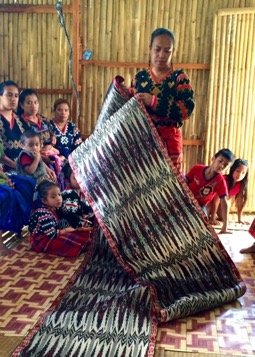
Abaca cloth is woven from the outer sheath of the trunk of a banana species indigenous to the Philippines.

http://www.tmasc.org/default.htm The Tboli and Blaan people of the southernmost island of Mindanao in the Philippines offers some of the most beautiful, skillful and sacred examples of material culture to be found throughout Southeast Asia. The weaving of the abaca ikat fabric (tnalak) has become synonymous with the Tboli, as has their intricate beadwork, embroidery and brasswork which richly decorates their garments. The Blaan, sister tribe to the Tboli, weave their own treasured and rare abaca ikat cloth (tabih). Their spectacular heirloom garments are adorned with impressive patterns of hand-hewn, mother-of-pearl beads. Independent researcher and collector Craig Diamond presents the ikat weaving traditions of both tribes as well as identifying and discussing the impressive garments worn by both the men and women.